Training Timing & Coordination: How the Interactive Metronome Impacts Attention, Motor Control and Brain Function

Timing is the invisible scaffolding of behavior. Whether we’re catching a ball, following a conversation, or staying focused in class, the brain depends on precise timing and coordination across sensory, motor, and cognitive systems. The Interactive Metronome (IM) is a training tool that zeroes in on that millisecond precision. By teaching the nervous system to predict and produce actions with improved temporal accuracy, IM often leads to gains in attention, smoother motor control, and measurable changes in brain function.

Below I’ll explain what the Interactive Metronome is, why timing matters neurologically, how IM drives change, and what patients typically experience. I’ll also describe how IM fits into a broader functional neurology program and include an anonymized patient story based on clinical experience at the Functional Neurology Brain Center of Florida.
What is the Interactive Metronome?
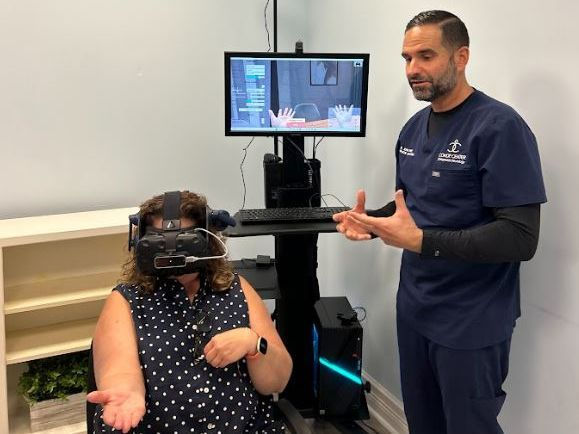
The Interactive Metronome is a computer-assisted training system that uses a rhythmic beat and motion sensors to train people to synchronize movements with precise timing. During a session, a client taps a hand, foot, or uses other simple movements to match an audible beat. The system records the timing of each movement relative to the beat — in milliseconds — and provides immediate feedback so the person can refine their timing. Training is short, engaging, and game-like, but the emphasis is on reducing timing errors and increasing consistency.
Small numerical improvements in timing can translate into meaningful functional gains because the brain’s sensorimotor and cognitive systems operate on very fast timescales. The IM is designed to address that fine-grained temporal accuracy.
Why timing and coordination matter for attention and motor control
Think of the brain as an orchestra: different regions must play in time for coherent behavior to emerge. The cerebellum, basal ganglia, brainstem, and cortical networks all contribute to temporal precision. When timing slips, the brain struggles to align incoming sensations with motor plans or to bind information in working memory. This can show up as:
Difficulty sustaining attention or switching appropriately between tasks
Clumsy or poorly coordinated movements (e.g., messy handwriting, poor balance)
Inconsistent reaction times and variable performance
Problems with rhythm-dependent skills like speech fluency and reading
Improving temporal precision lets neural systems communicate more reliably — and that improved communication underlies better attention and motor function.
How IM training affects the brain: a practical neuroscience view
Interactive Metronome training targets basic mechanisms of neural timing and synchronization:
1. Stronger sensorimotor integration. Repeatedly producing a movement at a precise moment and getting immediate feedback helps the nervous system refine predictive models about sensory consequences of actions. That means smoother, less corrective movement.
2. Enhanced cortico-cerebellar and cortico-basal ganglia loops. These circuits are central to timing, sequencing, and motor learning. Targeted practice drives plasticity in these networks, improving motor planning and execution.
3. Improved attentional control. Timing training appears to increase the efficiency of frontoparietal networks involved in sustained and selective attention. More reliable timing helps the brain allocate resources to relevant stimuli and ignore distractions.
4. Better neural synchrony. Consistent timing of neural firing supports more effective communication between brain regions. IM’s millisecond-level training encourages the brain to adopt activity patterns that support consistent behavior and cognition.
IM doesn’t “teach attention” in isolation. It builds a temporal foundation — the milliseconds of precision — that attention, motor control, and higher cognitive functions rely on.
What does IM feel like in therapy?
IM sessions are engaging and progress-driven. People enjoy the real-time feedback and the clear numbers showing improvement. Exercises are scalable: clients start with single-limb taps and progress to bilateral tasks and cognitive-motor combinations. Sessions are brief but frequent practice is essential; most programs last several weeks and are designed to push timing accuracy while keeping tasks achievable and motivating.
An anonymized patient case: “Ava’s” story
To illustrate real-world impact, here’s an anonymized patient story based on cases we see at the Functional Neurology Brain Center of Florida.
Ava, age 9, was bright but struggled in school with attention and coordination. She had slow, cramped handwriting, lost her place while copying from the board, and regularly knocked over items. She had an ADHD diagnosis and co-occurring motor planning challenges. Baseline testing showed variable reaction times and larger-than-expected timing errors on simple sensorimotor tasks.
We introduced a 12-week IM program with twice-weekly sessions, combined with targeted vestibular and visual exercises to improve sensory processing. As Ava practiced tapping to the beat and progressed to bilateral and cognitive-motor drills, her average timing error dropped significantly. Teachers noticed she began following multi-step directions more consistently; her handwriting spacing and speed improved, and standardized attention measures showed gains. Parents reported she was less frustrated and more willing to try tasks that had previously overwhelmed her.
Ava’s progress shows how IM’s focus on temporal precision can translate to meaningful everyday improvements — particularly when integrated into a comprehensive functional neurology plan.
IM within a broader rehabilitation toolkit
Interactive Metronome is a powerful tool, but it works best as part of a well-rounded approach. At the Functional Neurology Brain Center of Florida we routinely combine IM with complementary assessments and technologies for a full picture of function:
For visual and vestibular alignment, our Eye Tracking & VNG Vestibular Brain Assessment helps ensure sensory inputs are processed accurately, which is critical for timing-based training.
For speed, reaction, and visuomotor precision, tools like the Fitlight Trainer offer dynamic drills that reinforce quick decision-making and motor responses — a natural complement to IM’s timing emphasis.
IM is one of several emerging technologies we use to evaluate and train brain function; when combined, these approaches often produce more robust outcomes.
If you’re wondering whether IM or functional neurology fits your needs, our “Is Functional Neurology Right for You?” page can help explain the process, benefits, and what to expect.
Who benefits from IM?
IM is commonly used with children and adults who have attention challenges, learning-related timing difficulties, post-concussion symptoms, developmental coordination disorder, or conditions affecting motor planning. To learn more about the populations we typically treat, visit our Who We Treat page.
Final thoughts
Timing and coordination are foundational to how the brain organizes attention and movement. The Interactive Metronome offers a practical, neuroscience-informed method to sharpen that foundation. In clinical practice, IM is most effective when integrated into a personalized plan that may include vestibular and visual rehabilitation, cognitive-motor training, and other evidence-based tools.
We combine objective testing, tailored therapies, and the latest technologies to help people reclaim attention, improve motor control, and build confidence. If you’re ready to take the next step, contact the Functional Neurology Brain Center of Florida for a consultation — we’re happy to discuss whether Interactive Metronome training could be part of your plan.