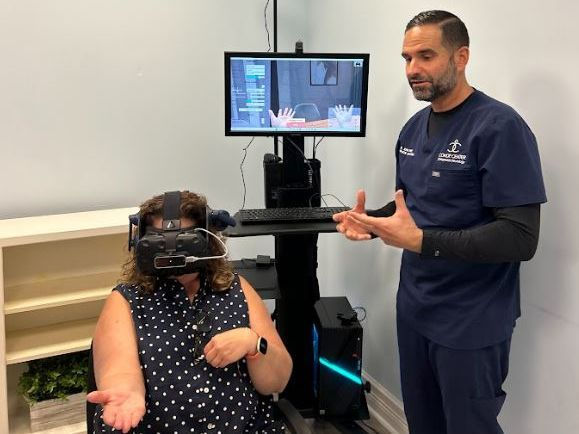
Inside Virtual Reality Neurotherapy: Using Medical VR to Support Brain Recovery in Florida

Have you ever wondered what it feels like for the brain to rehearse a task, challenge a reflex, or rebuild a pathway in a virtual realm? At the heart of modern brain rehabilitation, medical virtual reality (VR) is no longer science fiction—it’s a precise, evidence-based tool that clinics in Florida are using to support patients recovering from brain injuries, dizziness, and cognitive challenges.

At the Functional Neurology Brain Center of Florida, we’ve integrated medical VR protocols not as a supplement, but as a core component of neuro-rehabilitation for those who need more than standard care. If you’re exploring brain recovery options in Orlando or Central Florida, here’s what you should understand.
What is Medical VR in Brain Recovery?
Put simply, “medical VR” refers to immersive, computer-generated three-dimensional environments in which a person can safely practice tasks, movements, or scenarios that challenge the brain’s balance, coordination, cognitive and sensory systems. These environments can:
Mimic real-world situations (walking along a narrow path, reaching for objects, reacting to visual-audio signals)
Provide immediate feedback (you reached the target, you maintained balance, you tracked the moving object)
Gradually scale difficulty as the brain becomes stronger and more adaptive
In neuro-rehabilitation, this matters because the brain doesn’t simply “heal” on its own—it rewires. We call that neuroplasticity: the brain’s capacity to form new connections, reorganize pathways, and restore function. Research confirms that VR environments can engage multiple systems at once—visual, vestibular (balance), proprioceptive (body sense), motor, and cognitive—to stimulate this adaptation.
Why VR Works for Brain Recovery (and Why It Matters in Florida)
Here’s what makes VR so powerful when you’re recovering from a concussion, vestibular dysfunction, stroke, or other neurological event:
Controlled complexity: Unlike real-world tasks that may be unpredictable or unsafe, VR offers controlled challenge—meaning you can safely practice and progress.
Sensory integration: The brain recovers best when systems communicate. VR can engage vision + hearing + movement together, which helps retrain how the brain processes information.
Feedback and motivation: The immersive nature of VR, the “game-like” environment, keeps engagement high, which improves compliance and outcomes. A motivated brain learns faster.
Data-driven tracking: Many VR systems track performance metrics—reaction time, accuracy, speed, balance stability—so progress is visible and measurable.
Early intervention advantage: For patients in Florida, where outdoor activities, active lifestyles, and quick return to function matter, VR supports a more efficient path to recovery.
Addressing “invisible” issues: Symptoms such as brain-fog, delayed reaction times, and subtle balance deficits don’t always show on standard tests—but VR can uncover and train them.
At our center, we use medical VR with people experiencing dizziness, visual-vestibular issues, concussions that still linger, and cognitive fatigue. These are conditions that often fall between the cracks of traditional care—so bringing VR into the mix provides a new pathway to improvement.
Who Should Consider VR Neurotherapy?
Medical VR is not a cure-all, but it’s remarkably versatile when applied thoughtfully. Those who may benefit include:
Patients with persistent symptoms from a concussion or mild traumatic brain injury, especially if standard care hasn't fully resolved dizziness, cognitive delay, or visual-vestibular issues.
Individuals with vestibular problems (chronic vertigo, imbalance, motion sensitivity) where the brain’s integration of visual-vestibular input is disrupted.
Stroke or brain-injury survivors looking to rebuild coordination, reaction time, and dual-task processing.
Active adults or athletes in Florida who need to restore not just function, but performance (balance, reflexes, spatial awareness).
People concerned about subtle neurological symptoms such as slow reaction time, brain-fog, or balance hits—they might not “look bad” but they feel off.
For an overview of whether functional neurology is the right path, check our article: Is Functional Neurology Right for You? And for a deeper look at neurological symptoms you should not ignore, see: Neurological Symptoms Not to Ignore
What Does the Research Say?
The scientific literature backs up what we’re seeing in clinic. One 2025 review states: “By creating dynamic, immersive, and task-specific environments, VR can foster neuroplasticity and re-engage damaged neural circuits.” Another study highlighted VR’s feasibility and safety in acute neurorehabilitation settings. While research continues to evolve, early evidence consistently supports the value of VR when used under guided, clinical supervision.
What to Ask When Exploring VR Neurotherapy
If you’re considering VR neuro-therapy in Florida, here are key questions to ask:
Is the VR program customized to my specific brain-system deficits (vision, balance, reaction time, cognitive speed)?
Are there progress metrics being tracked so that we can see measurable improvements?
How does this fit into a comprehensive program (not just VR alone) — for example including vestibular rehab, functional neurology assessment, neuro-optometric components?
What safety protocols are in place (especially if you’ve had dizziness or motion-sensitivity)?
How will improvements carry over into my daily life (not just the VR environment)?
Is the provider experienced in working with patients similar to me (concussion, vestibular, brain injury)?
Why It Matters in Florida
Florida’s active, vibrant lifestyle means people expect to bounce back quickly. Whether you’re returning to golf, swimming, commuting, or simply enjoying daily life without dizziness, medical VR offers a cutting-edge option to accelerate and deepen recovery. In a place like Orlando or Central Florida, where patients often want not only “better” but “better and back,” integrating VR into brain rehabilitation makes sense.
Final Thoughts
Medical VR is one of the most exciting developments in functional neurology and brain recovery. It gives the brain a dynamic playground to rebuild, refine, and reconnect. At Functional Neurology Brain Center of Florida, we believe that technology alone isn’t enough—it’s the combination of advanced tools, expert clinicians, and personalized programs that drive outcomes.
If you’re navigating recovery from a brain injury, persistent dizziness, cognitive delay or simply want to optimize your brain-body performance, exploring a VR-integrated approach is worth your time. For more information about our programs, visit our Virtual Reality Therapy page.